AEO Services: How ATLAS AEO Gets Your Business Recommended by AI
 By Shaheen Arif, Founder, GetServices.ai · · 14 min read
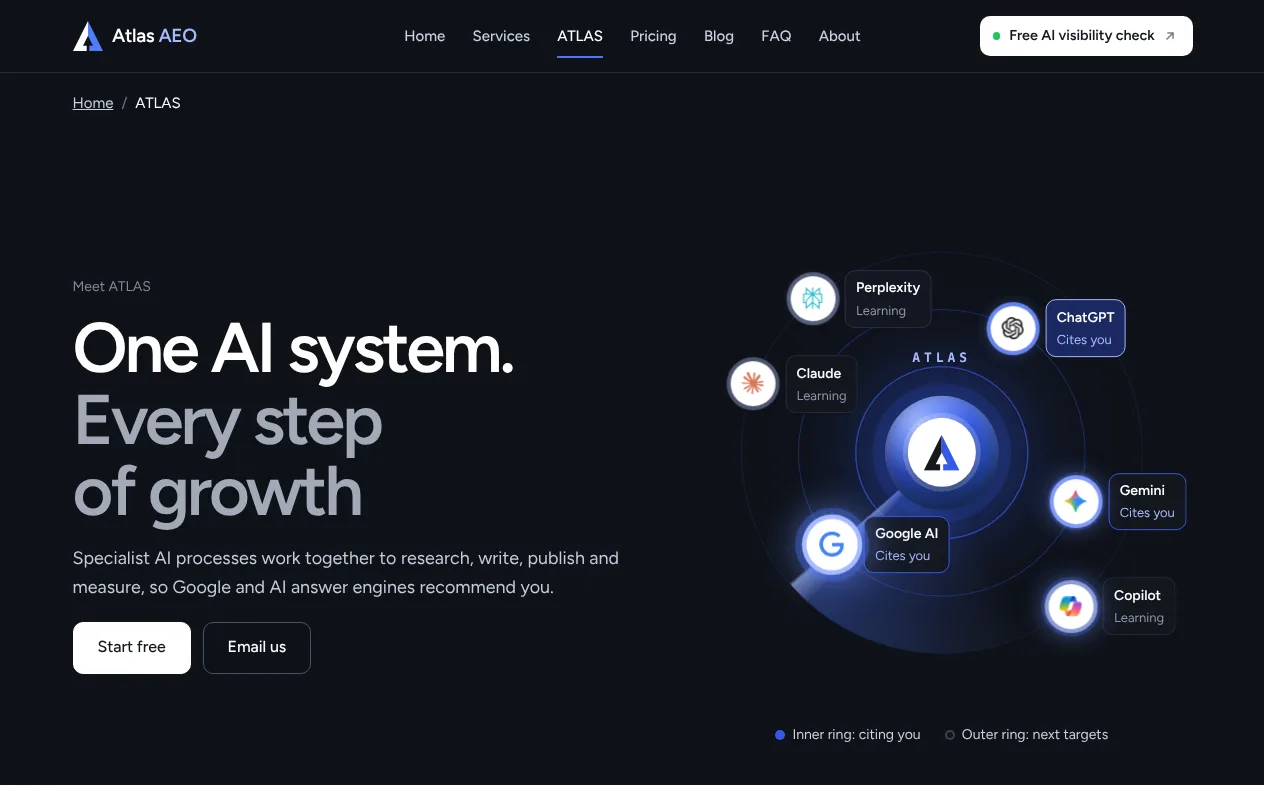
Screenshot: the ATLAS overview on atlasaeo.net, November 2026.
Key takeaways
- AEO and SEO work together. AI answers draw on pages that search engines can crawl and trust, so good AEO keeps your SEO foundations strong.
- Six services cover the job: an AI visibility check, an AEO audit, AEO optimization, AI search strategy, schema markup and citation building.
- ATLAS runs a loop of discover, diagnose, create, publish and learn, so the work doesn't stop after one report.
- You choose how much control to keep: approve everything, add a human review, or let ATLAS publish routine work.
- Plans run from Free to Starter at $49, Growth at $149 and Enterprise at $399 a month.
- Be wary of guarantees. No honest provider can promise AI citations; look for measurement you can check yourself.
What are AEO services?
Answer engine optimization, or AEO, is the work of helping your business appear inside the answers that AI assistants write. When someone asks ChatGPT "who is the best accountant for a small restaurant in Boston?", the assistant doesn't show ten blue links. It writes one answer, names one or a few businesses, and sometimes cites its sources. AEO is about being one of those names, and being described correctly.
An AEO service is the ongoing practice of making that happen. It usually includes five kinds of work:
- Measurement: finding out which questions matter to your buyers and what AI assistants say about you today.
- Diagnosis: checking whether AI crawlers can read your site, whether your pages answer real questions clearly, and whether trusted third-party sources describe you accurately.
- Content: writing or rewriting pages so they give direct, well-structured, evidence-backed answers.
- Structure and trust: adding schema markup and building accurate citations on the sources assistants rely on.
- Tracking: repeating the measurement to see what changed, then planning the next round of fixes.
Some agencies sell only one of these, such as a one-off audit. The value comes from doing all five in a loop, because AI answers change as the web changes.
How is AEO different from traditional SEO?
Traditional SEO competes for a ranked position on a results page. You might sit fourth and still win clicks. AI answers are less forgiving: it used to be ten links and a fight for clicks; now it is one answer, and you're named or you're not.
That said, AEO doesn't replace SEO. Google says the same best practices apply to its AI features as to Search in general: pages need to be crawlable, indexable and genuinely helpful. If your site is slow, poorly structured or hard to crawl, it is unlikely to be cited. That is why ATLAS works on AEO and SEO together, so you stay visible on Google too.
Why does AEO matter now?
More people ask an AI assistant before they buy. They ask for a recommendation, a comparison or a price, and they act on the answer. If an assistant doesn't know your business, doesn't trust what it finds, or describes you wrongly, you lose that customer without ever knowing they looked.
Three things make this urgent for small and mid-sized businesses:
- Fewer slots. A generated answer might name three businesses where a results page showed ten, so the competition for each mention is tighter.
- Hidden losses. Lost AI visibility doesn't show up as a drop in rankings, and a lot of AI traffic lands as "Direct" in analytics. Our guide on how to check if ChatGPT mentions your business shows a free way to measure it.
- Accuracy risk. Assistants sometimes repeat outdated prices, old addresses or services you no longer offer. Those errors cost you customers even when you are recommended.
The good news is that the signals assistants rely on can be understood and improved. AEO services exist to strengthen those signals in a planned, measurable way.
What do the six ATLAS AEO services do?
ATLAS AEO groups its work into six services. You can start with one, but most businesses get the best results when they run together under one plan.
1. AI Visibility Check
The AI Visibility Check shows where answer engines mention, cite or leave out your business for the questions your customers ask. It is the baseline for everything else: without it, you can't tell whether later work made a difference.
You can run a free scan yourself on app.getservices.ai. Enter your website and ATLAS returns a snapshot of your AI visibility, search visibility, technical health and competitor gaps, with no account needed.
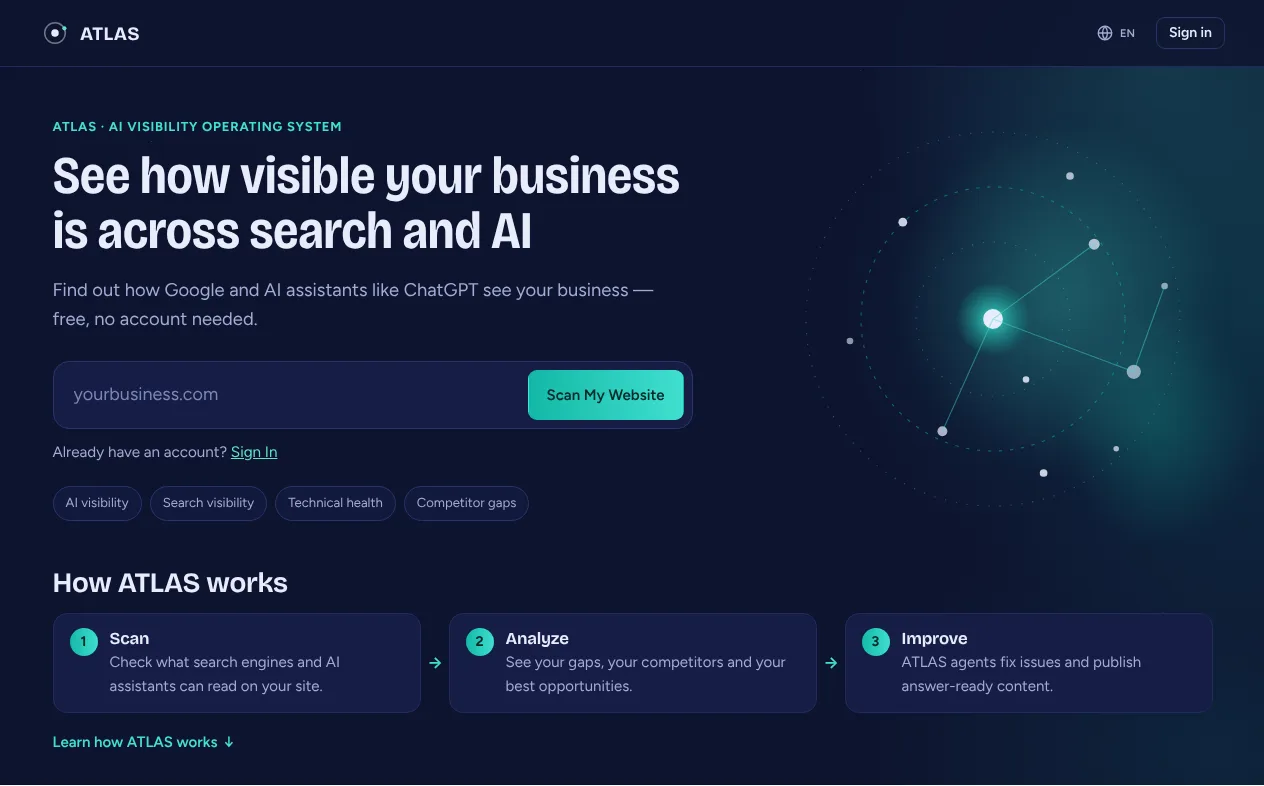
The free scan on app.getservices.ai. Tip: enter your main domain, such as yourbusiness.com, without "https://".
2. AEO Audit
The AEO Audit finds the technical, content and citation gaps that make it harder for AI to reference you. The technical side checks crawl access, broken links, meta tags, structured data, sitemaps and mobile speed. The content side looks at whether your pages answer real buyer questions directly. The citation side checks whether trusted sources describe you consistently.
Every finding is ranked by impact, so you know what to fix first. A typical list might include adding FAQ schema to service pages, answering pricing questions on the home page, writing missing meta descriptions, or adding author bios to blog posts.
3. AEO Optimization
AEO Optimization makes your key pages easier to understand and cite, with better answers, structure and evidence. In practice that means:
- Opening each page with a clear, direct answer to the question it targets.
- Breaking long pages into scannable sections with descriptive headings.
- Adding FAQs that match how people really phrase their questions.
- Backing claims with specifics such as prices, service areas, credentials and dates.
- Improving titles, descriptions and internal links so search engines understand how pages relate.
ATLAS writes answer-first articles and checks them before they publish, so drafts are reviewed for clarity and errors before anyone sees them.
4. AI Search Strategy
The AI Search Strategy service answers a simple question: which questions should you answer, and in what order? ATLAS finds what customers ask right before they choose, checks what AI answers today, and maps the gaps against your competitors. If you want to start this by hand, our guide to finding the questions customers ask before they buy walks through it.
Two research tools feed this strategy: Google Trends Radar spots rising topics in your market, and the Opportunity Tower ranks the openings worth acting on. Both are included in Growth and Enterprise and can be added to Starter.
5. Schema Markup
Schema markup is a structured description of the facts already on your pages: who you are, what you offer, where you work and what people ask about you. It doesn't add new claims. It makes existing facts easy for machines to read without guessing. ATLAS generates schema alongside sitemap.xml and robots.txt, so search engines and AI crawlers can find and interpret your pages.
6. Citation Building
Citation Building puts accurate, complete business information on the third-party sources AI trusts, such as business profiles, directories and review platforms. Assistants often cross-check what your site says against what others say about you. When those sources disagree or are missing, the assistant may leave you out or describe you wrongly. Aligning your public profiles with your service pages is one of the most common high-impact fixes ATLAS recommends.
How does ATLAS run the work?
Behind the six services is ATLAS, the AI system that powers ATLAS AEO. Instead of a tool that produces one report and stops, ATLAS uses specialist AI processes that research, write, publish and measure together in one workspace.
| Step | What ATLAS does |
|---|---|
| Discover | Finds buyer questions, trends and competitor gaps. |
| Diagnose | Checks crawl access, speed, schema and trust signals. |
| Create | Writes answer-first articles, FAQs and schema. |
| Publish | Releases work to WordPress, GitHub or HTML sites and checks it live. |
| Learn | Measures traffic, rankings and AI mentions, then plans the next round. |
Because the loop repeats, ATLAS keeps improving: each round of measurement feeds the next round of content and fixes.
What lives in the ATLAS workspace?
- Overview: your AEO and SEO scores and the next best steps.
- Opportunity Tower: every fix, ranked by impact.
- Research and trends: rising topics and buyer questions.
- Topic map: how your content fits together, with internal-link recommendations.
- Content studio: drafting, proofreading and approvals.
- Site health: technical audits and mobile speed checks.
- Authority: trust and citation signals.
- Analytics: traffic, rankings and a weekly progress report.
- Competitor watch: competitor scans and alerts when rankings move.
There is also a social and video area. The optional social media hub lets ATLAS prepare posts for your connected accounts, and credits can be used for short vertical videos and longer explainer videos.
What does an ATLAS report show you?
A report answers three questions in plain language: are you mentioned, are you cited, and what should you fix next? It shows your AEO score, whether each major assistant cites you, mentions you or doesn't find you, your share of AI answers against named competitors, and a ranked list of opportunities.
What results has ATLAS produced?
Before offering ATLAS to clients, GetServices.ai ran it on its own brand-new site, bostondaily.us. The site started on a fresh domain with no backlinks and no ads, and its pages were built by ATLAS's automated AEO and SEO publishing.
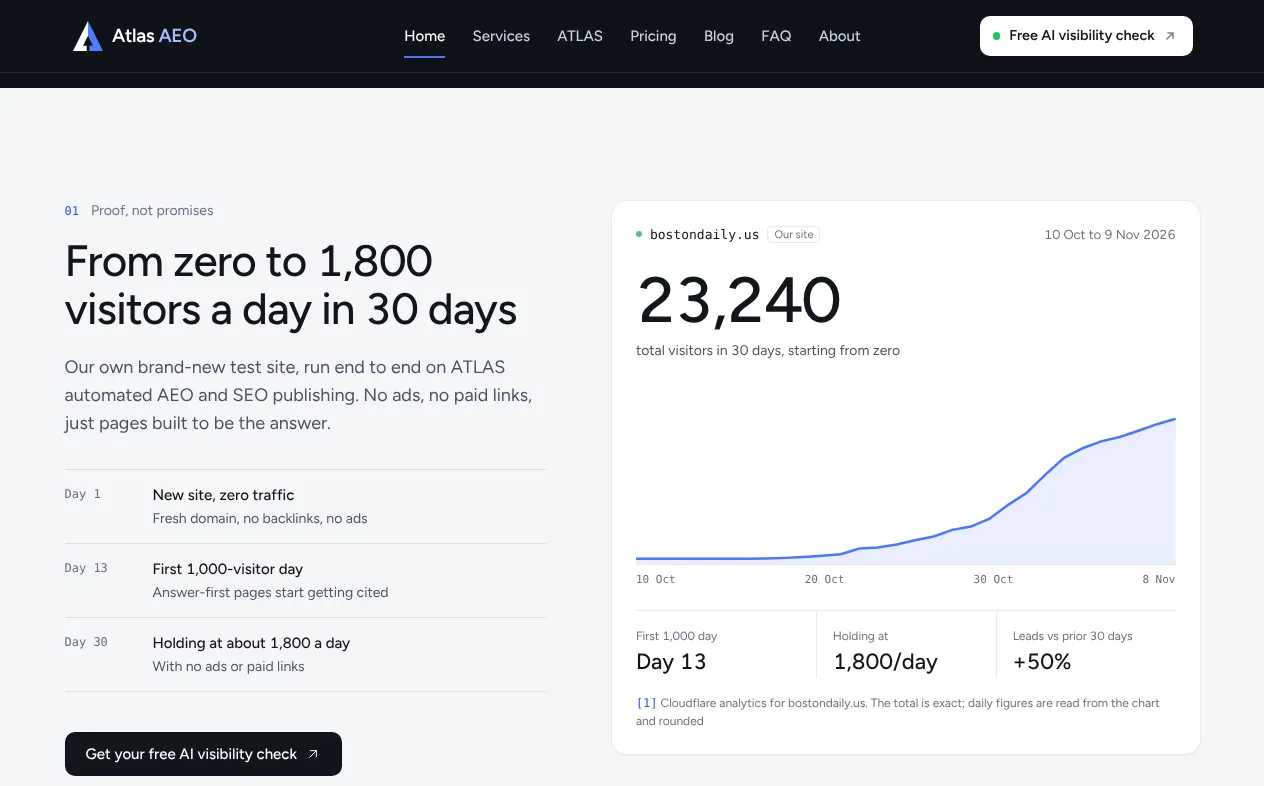
Traffic to bostondaily.us, 10 October to 9 November 2026, from Cloudflare analytics, as shown on atlasaeo.net.
- Day 1: new site, zero traffic.
- Day 13: the first 1,000-visitor day.
- Day 30: holding at about 1,800 visitors a day, with no ads or paid links.
- Total: 23,240 visitors in the first 30 days, with leads up 50% on the prior 30 days.
How much control do you keep?
Handing your website to an AI system can feel risky, so ATLAS lets you choose how hands-on you want to be, and you can change your mind later.
- Guided: you approve articles, images and posts before anything goes live. This is the safest place to start.
- Human in the loop: a GetServices.ai FDE (forward-deployed engineer) checks the work before it publishes. This is an optional paid add-on that suits regulated industries or brands with strict tone rules.
- Automatic: ATLAS publishes routine work without waiting for approval, within the channels you allow. This suits teams who have seen enough Guided output to trust it.
Whichever mode you choose, publishing only happens on accounts you connect, and changes are checked live after they go out.
What do AEO services cost?
AEO pricing varies widely, from one-off audits to monthly retainers. ATLAS AEO uses simple monthly plans plus credits, so you pay for the work ATLAS actually does. Prices are in US dollars as of November 2026.
| Plan | Price | Websites | Articles included |
|---|---|---|---|
| Free | $0 | 1 | 50 sign-up credits to try ATLAS |
| Starter | $49/month | 1 | 3 a month, 1,200 to 1,500 words each |
| Growth | $149/month | 3 | 7 to 10 a month, with every feature included |
| Enterprise | $399/month | 10 | Planned per website, with every feature and the social media hub included |
How do credits work?
Scans, fix kits and publishing are free. Credits cover the heavier work: keyword research costs 2 credits, a full ATLAS run 5, a full article 10, a short vertical video 15 and a longer video 40. Paid plans add credits every month, and you can buy one-time top-ups from $19 for 200 credits. Checkout runs through Stripe, with invoices and a customer portal to manage your plan.
Which add-ons are there?
Starter customers can add Google Trends Radar, the Opportunity Tower, Competitor Watch Plus, extra credits or an extra website. Growth customers can add extra websites. The social media hub is $29 a month on Starter and $49 on Growth, and included in Enterprise.
Not sure which plan fits? Start with the free scan, then choose a plan once you can see the results.
How do you choose an AEO provider?
AEO is a young field, and offers range from real expertise to repackaged keyword tools. Whoever you hire, these questions will help you judge them.
- Do they measure AI answers directly? A real AEO service checks what assistants actually say about you for a fixed set of buyer questions, and repeats that check over time. Rankings alone don't tell you whether ChatGPT names you.
- Do they cover technical, content and citations? Fixing only one rarely works. Great content on a site AI crawlers can't read won't be cited, and a technically perfect site with thin answers won't be either.
- Do they publish, or only advise? Many audits end as a PDF nobody acts on. Ask who writes the content, who applies the fixes and how often.
- Can you approve the work? Your website speaks for your business. Make sure you can review content before it goes live, at least at the start.
- Do they promise guaranteed citations? Be cautious if they do. Nobody controls what an AI assistant says, and answers vary between sessions. What a provider can promise is honest measurement and steady work on the signals that matter.
- Is pricing clear? Look for published prices and a way to start small.
How do you get started with ATLAS AEO?
- Run the free scan. Enter your website on app.getservices.ai to see how Google and AI assistants see your business today.
- List your buyer questions. Write down 10 to 20 questions customers ask right before they choose you. ATLAS adds more from its own research.
- Pick a plan. Start on Free, or choose Starter, Growth or Enterprise.
- Connect your site. Link your WordPress, GitHub or HTML site so ATLAS can publish approved work.
- Choose your control level. Start in Guided mode and approve the first few articles yourself.
- Review the weekly report. Watch your AEO score, AI mentions and traffic, and act on the top items in your opportunity list.
Prefer to talk first? Email [email protected] with your website and the questions you want customers to find you for, or read about AEO and SEO services from GetServices.ai.
Frequently asked questions
What are AEO services?
AEO (answer engine optimization) services help AI assistants such as ChatGPT, Google AI Mode, Perplexity, Gemini and Copilot find, trust and name your business when people ask questions. They combine a visibility check, an audit, page improvements, schema markup, citation work and ongoing measurement.
How is AEO different from SEO?
SEO helps your pages rank in search results. AEO helps your business appear inside generated answers, which often name only a few businesses. They overlap heavily, because AI answers draw on pages that search engines can crawl and trust.
How much does ATLAS AEO cost?
There is a Free plan with 50 sign-up credits, Starter at $49 a month, Growth at $149 a month and Enterprise at $399 a month. One-time credit top-ups start at $19 for 200 credits.
Can I check my AI visibility for free?
Yes. The scan on app.getservices.ai shows how Google and AI assistants see your website, with no account needed.
How long does AEO take to work?
It depends on your starting point and competition. On our own new site, bostondaily.us, the first 1,000-visitor day came on day 13. Results vary, and no provider can guarantee AI citations.
Do I have to approve everything ATLAS publishes?
You choose. In Guided mode you approve everything before it goes live, human-in-the-loop review adds a check by a GetServices.ai FDE, and Automatic mode publishes routine work within the channels you allow.
Does ATLAS AEO guarantee rankings or AI citations?
No. Nobody controls what an AI assistant says. ATLAS improves the signals answer engines rely on and measures the results honestly, but rankings and citations are not guaranteed.
See where you stand today
Run the free ATLAS AEO scan to see how AI assistants and Google read your site, and what to fix first. No account needed, and no result is guaranteed, but you'll know where to start.
Run my free AEO scanRelated reading
- The ATLAS AEO blog: all guides
- How to Check if ChatGPT Mentions Your Business
- How to Find the Questions Your Customers Ask Before They Buy
- What Is AEO? (atlasaeo.net)
- AEO and SEO services from GetServices.ai
- GetServices AI Studio
- GetServices.ai